Honor's Strong Q2 Performance Signals Tablets Aren't Fading Yet
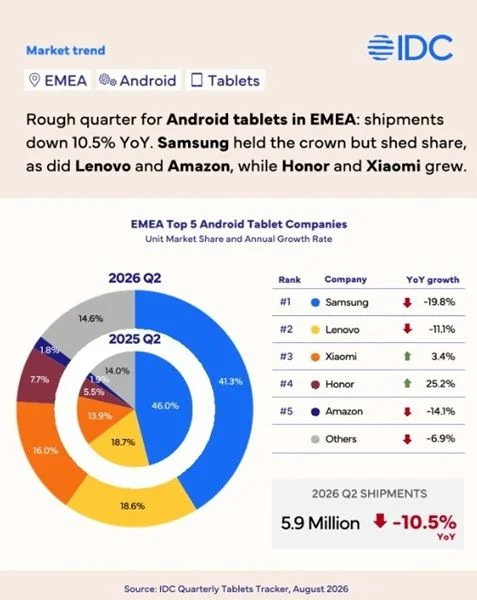
Honor is making a notable mark in the Android tablet segment, defying trends highlighted in a recent IDC report on the EMEA market for Q2 2026. The report reveals a 10.5% year-over-year decline in Android tablet shipments within the region, dropping to 5.9 million units. Surprisingly, while most brands faced setbacks, Honor achieved impressive growth with a 25.3% increase in shipments, standing out as the only Android manufacturer to register significant growth apart from Xiaomi, which saw a modest 3.4% increase.
Market Dynamics: Honor's Rise Amidst General Decline
In a market that's generally contracting, Honor's performance raises eyebrows. The IDC report paints a picture of a struggling category, yet here comes Honor, not just holding its ground but actively expanding. What makes this even more fascinating is the broader trend among Android tablet manufacturers wrestling with declining shipments. A 10.5% drop is substantial, indicating a shift in consumer habits or perhaps a gravitation towards multifunctional devices that blur the lines between tablets and smartphones.
So, what's driving Honor forward while others falter? According to Daniel Goncalves, IDC's senior research manager, Honor's growth can largely be traced back to its established presence in the smartphone market. This foundation has likely enabled Honor to leverage its existing customer base and brand loyalty to venture into tablets without the usual pitfalls associated with entering a new product category. It seems, at least for now, that Honor's strategy is resonating with consumers. The question is: can this momentum be sustained?
Honor's MagicPad 4: A Leap Forward
At the forefront of Honor's resurgence is the release of their latest tablet, the MagicPad 4, which features a remarkable OLED display. This new screen technology surpasses the standard resolution of the LCD panels that previously characterized Honor's offerings. Expert reviews have noted the tablet's impressive 5,320Hz PWM dimming, an essential feature that enhances visual comfort and usability—something that many competitors neglect to implement.
The MagicPad 4's OLED display isn't just a flashy feature; it signifies a strategic shift in how Honor approaches its tablet lineup. The transition to OLED is critical as users have come to expect high-quality displays that can manage brightness and color without the drawbacks of traditional screens. This aligns perfectly with the growing consumer demand for devices that prioritize user experience. And let’s face it, how many times have you tried scrolling through a website on an underwhelming display? Exactly.
The Bigger Picture: Tablets in Focus
Tablets often seem overlooked in the tech ecosystem, overshadowed by the rapid innovation in smartphones. Despite this, they remain relevant, especially with advancements that cater to user needs. The latest trends in the phone market, including foldables that serve dual purposes, show decreasing demand—a 4% drop in global shipments due to the ongoing memory shortage. In contrast, Honor's tablet strategy suggests that there’s potential for growth even in a contracting market.
Now, here's the thing: while smartphones continue to get all the love and attention, tablets have their own unique advantages. For many, the larger screen real estate enhances tasks like note-taking, media consumption, or even productivity work through apps that benefit from spacious displays. Yet, with a contraction in consumer interest in tablets, Honor's gains challenge the assumption that tablets are on their way out. It could indicate that consumers are looking for specific features that satisfy their needs rather than settling for generalist devices.
Industry Perspective
From my perspective, I find myself questioning the role of tablets in today’s digital landscape. While I appreciate their capabilities, I often wonder if purchasing one is necessary, especially since smartphones and PCs fulfill most my tasks. However, my previous experiences with tablets suggest they hold unique utility that can complement—not replace—existing devices. They offer portability without sacrificing the kind of functionality found in laptops.
And this is the part most people overlook: just because they aren't the newest fashionable gadget doesn't mean tablets lack importance. A well-functioning tablet can act as the perfect secondary device for specific tasks, bridging the gap between cumbersome laptops and limited smartphones. As Honor continues to challenge the status quo with its offerings like the MagicPad 4, it’s clear there’s still a significant opportunity for tablets to carve out their niche in a competitive market.
Future Outlook: What Lies Ahead for Honor and the Tablet Market
The current situation paints a picture of potential resurgence in the tablet market, led by Honor's noteworthy performance. As the company positions itself to potentially disrupt the longstanding dominance of established players like Samsung, it’s a situation worth watching closely. If Honor continues its trajectory with impressive products and strategic marketing, it could well attract a broader audience.
The broader implications are significant: if Honor's growth is anything to go by, it might inspire other brands to revisit their tablet strategies or rethink how they position their products. It’s worth considering how consumer preferences are shifting, especially when those shifts manifest in surprising successes like Honor's recent gains. If you're working in this space, agility and awareness of user needs could be key differentiators in the fight for market share. In sum, Honor's journey could reshape expectations for Android tablets and challenge competitors to step up their game.