Exploring the Role of RocksDB in Local Storage for Cloud-Native Applications
Cloud-native architecture discussions have often centered on options like managed databases and distributed caches. The prevalent advice has been to route all data to centralized storage services. While this method suits many use cases, it incurs hidden costs, particularly in the form of network operations for each read and write, which can quickly add up. This reliance on centralized architectures could become problematic as businesses scale. The challenges of managing throughput, latency, and costs can often overshadow the purported benefits of ease and simplicity.
The Cost of Centralized Storage
As systems expand, engineers find themselves grappling with increased network latency, escalating storage expenses, and heightened operational complexities. It’s not merely a shortage of storage; rather, the excessive distance between processing nodes and their required data significantly impacts performance. Each time a read or write operation necessitates a network trip, delays stack up. This unwelcome lag can inhibit application performance, creating bottlenecks that frustrate users and developers alike. Businesses risk losing competitiveness if they cannot maintain optimal application responsiveness. With modern applications demanding real-time processing, relying heavily on centralized databases might not only introduce latency but also stress network infrastructure, leading to potential outages or failures.
RocksDB: A Tactical Approach to Local Data Management
This is where RocksDB addresses some of the most substantial infrastructure challenges in the industry. Created by Facebook and constructed atop LevelDB, RocksDB functions as an embedded key-value store optimized for rapid local storage. Unlike traditional databases, RocksDB operates within the application process, eliminating the need for separate database management, scaling, and patching. The local nature of RocksDB means that applications using it can store and access data faster compared to calling an external service, leading to improved throughput and reduced impact on network resources. This is more significant than it seems, particularly for applications operating at high velocity with transient data needs.
This approach might seem counterintuitive in an era dominated by managed services, but it effectively addresses a unique set of challenges. Many businesses initially buy into the allure of managed services, believing they simplify development. However, many forget that data locality plays a key role in overall efficiency. Keeping operational states close to the computation process reduces access times and streamlines workflows. In environments where every millisecond counts, displacing data from its processing location can often lead to unnecessary delays.
Efficiency in Event Processing
Imagine a Kubernetes platform handling millions of daily events. Every pod requires access to temporary states, checkpoints, and metadata. Continuous updates to a remote database can create significant latency and operational costs. The need for swift data retrieval is paramount, especially when events must be processed in real-time. If you're working in this space, you know that speed often translates directly into value. The faster an application can react to events, the better it serves its users and meets operational demands.
Consider a standard architecture that relies on network round trips for operations. With each operation dependent on external communication, the latency introduced can cause delays not just in processing, but in user experience. For every interaction that requires back-and-forth with a centralized database, you're adding potential sources of failure and sluggishness to your system.
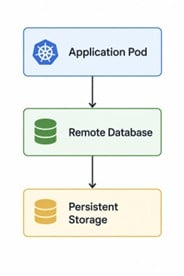
Now, contrast this with a setup where the application directly communicates with local storage. With RocksDB, applications no longer have to depend on remote resources for quick data access. Instead, they can handle reads and writes within the same pod, significantly cutting down on network traffic, reducing latency, and lessening reliance on external services for transient operational states. This change can be pivotal for latency-sensitive applications.
RocksDB in Action
Platforms such as Apache Kafka Streams exemplify this approach to localized data management. By integrating RocksDB for local state management, Kafka Streams allows processing nodes to access data swiftly without the need for constant querying of external databases. Improved throughput and diminished network overhead can lead to better scalability, which many developers are eager to achieve. Similar scenarios exist within stream processing systems, where the balance between speed and storage becomes critical.
Flink, too, has adopted a similar strategy, relying on RocksDB to manage operator state effectively. Both systems demonstrate that the principles of locality and efficiency drive modern cloud-native architectures. However, this principle isn't limited to stream processing; many cloud-native platforms need temporary data storage that doesn’t necessitate a centralized database. As more applications shift towards this model, it’s clear the demand for localized solutions will continue to grow.
Use Cases for Localized Storage
Typical scenarios where fast, localized storage excels include:
- Workflow checkpoints
- Session metadata
- Processing queues
- Intermediate computation results
- State machine transitions
- Caching layers
- Event processing offsets
By localizing frequently used state, teams can alleviate strain on centralized databases, thereby enhancing responsiveness. For instance, one team employed a centralized database to track workflow execution states. This setup functioned adequately initially, but latency escalated as workloads increased. By transitioning short-lived operational states closer to the processing nodes, they've not only reduced database demand but also significantly improved overall performance. This shift demonstrates how localized storage can drive efficiency, particularly in task-heavy environments.
Simple Integration with RocksDB
The straightforward nature of working with RocksDB is part of its allure. Developers appreciate its simplicity:
RocksDB Db = RocksDB.open("path/to/data");
db.put("workflow-123".getBytes(), "RUNNING".getBytes());
byte[] state = db.get("workflow-123".getBytes());
Without complicated server configuration or network dependencies, applications can directly interact with local storage. It's a refreshing contrast to the often cumbersome setups required by traditional databases. However, it’s critical to understand that RocksDB isn't a one-size-fits-all database solution. It can’t replace traditional databases that require intricate relational queries, multi-user access, or centralized governance. It shines in scenarios focused on performance where speed is paramount.
Its primary strength lies in keeping data physically close to computation, carving a niche that managed services can't always fill. As cloud-native architectures mature, engineering teams are realizing not every storage challenge equates to needing another distributed service. Sometimes, the optimal storage solution is already embedded within the application, underscoring the importance of locality in efficient data management.
Future Implications of Localized Storage Solutions
The rise of solutions like RocksDB hints at a broader shift in how storage and data access challenges are approached. As applications become increasingly complex and demand for instantaneous data processing escalates, businesses must question their reliance on centralized storage. Localized data solutions are not just a temporary fix; they represent a deeper understanding of efficiency and operational design. This mindset encourages engineers to consider where data lives in relation to the processing that consumes it. The implications are vast.
As more teams adopt this philosophy, we can expect to see a transformation in cloud-native architectures. Distributed systems that emphasize locality could pave the way for more resilient, responsive applications. The industry may well evolve into a phase where efficient data management becomes synonymous with localized solutions, shifting the balance away from centralized services. That said, a critical examination of each project’s requirements is always essential—success isn’t guaranteed just by choosing a faster storage solution. Rather, it's about aligning that choice with specific operational needs, resulting in systems that truly meet user expectations.