Google Opens Connected Apps Platform to Gemini and Search Developers
Google is giving developers a route to bring their apps into both Gemini and Search, expanding the places where people can use services through its AI experiences. The Connected Apps Platform entered developer preview on Oct. 28, with early integrations pointing to a wider mix of shopping, media, fitness, and wellness tools. The pitch is simple: let people call on outside services while they’re already using Google’s AI products. Whether that convenience turns into regular use will depend on how well the connections work and how much control users feel they retain.
One integration, two destinations
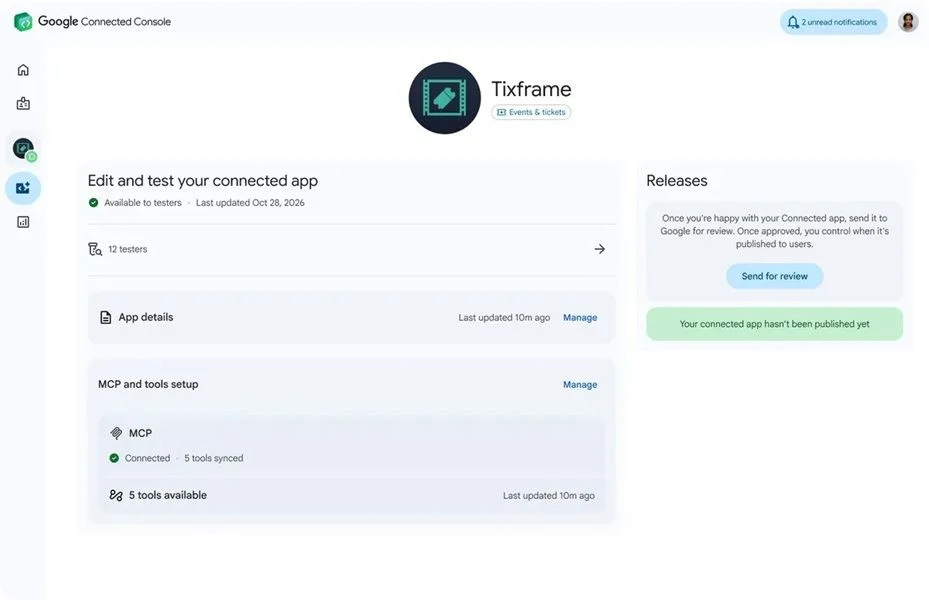
Developers can connect their products through a cloud-hosted MCP server, complete Google’s review process, then choose whether each app appears in Gemini, Search, or both. That gives providers a single route into two Google experiences, though a shared integration doesn’t guarantee the same user behavior in each one. Search and Gemini can bring different expectations: one may start with a specific query, while the other may be used for a longer exchange with an assistant.
The preview includes monitoring tools for traffic, latency, and error rates, giving teams a way to track how their integrations perform. Those measures matter because an app connection has to work at the moment a user asks for it; slow responses or failed handoffs can make the whole AI experience feel unreliable. The tools also give developers a way to see whether a presence in Google’s products is producing meaningful engagement, though the announcement doesn’t say what level of demand partners should expect.
Google describes the platform as a way to “build once and reach high-intent users.” That framing makes distribution the main draw: developers can bring an app into multiple Google surfaces through a single integration, while choosing where it’s available. It’s a useful proposition, but “high-intent” is a promise about audience quality, not evidence that users will complete a purchase or keep returning. For app makers, the appeal will hinge on whether the added reach justifies the work of connecting, passing review, and maintaining the integration.
Google’s announcement says Adobe, Experian, Localiza, and Peloton are among the services coming to Search in the weeks ahead. Many are already available in Gemini. Calm is also expected to join Gemini and Search soon. The range suggests Google wants the feature to cover more than one kind of task, from creative tools and fitness to shopping and wellness, although the list alone doesn’t show how deeply each service will be integrated. Developers can sign up for the preview.
AI tasks still need a human checkpoint
Connected Apps already let Gemini and Google’s AI Mode handle practical tasks across services. Instacart, YouTube Music, and Canva joined AI Mode this summer. With Instacart connected, a user can ask the AI to assemble a grocery cart for an event; with YouTube Music, it can help create playlists. These examples show the range of work an assistant can coordinate, from collecting items for a possible purchase to shaping a listening session. They also point to a distinction between suggesting or preparing an action and carrying it through.
The shopping flow keeps the user in view: the AI shows its actions and signals when it reaches payment, then hands off to Instacart to complete the purchase. That checkpoint reflects the tradeoff at the heart of these integrations. AI can take routine steps off a user’s hands, while people retain control over consequential actions and which apps they connect. The handoff is a sensible design choice, but it also makes the quality of the transition important: users need to understand what the assistant has prepared before they decide whether to proceed.
This is more significant than it looks. A connection that can assemble a cart or build a playlist changes an assistant from a source of suggestions into a route for getting something done. And yet, every extra service adds another point where context can be misunderstood, a response can fail, or a user can lose track of which company is handling the next step. (And this is the part most people overlook.) The user experience depends on more than the AI’s answer; it depends on the partner app’s response and the handoff between them.
What the preview will reveal
Google has indicated that more services are on the way. The developer preview gives those providers a clearer path into Gemini and Search, while the expanding lineup will show how far users want AI assistants to act across their apps. If you’re working in this space, the practical question is whether users will welcome a single assistant coordinating tasks across services, or prefer to open each app directly when an action matters.
That answer won’t come from the partner list alone. It will depend on whether integrations are fast, predictable, and clear about when control passes to another service. Google is widening distribution for app makers, but it still has to demonstrate that users will trust the experience enough to use it repeatedly. For now, the preview is a test of that proposition. Convenience, in practice.