Google Gemini Adds Interactive Visual Lessons to Its Student Hub
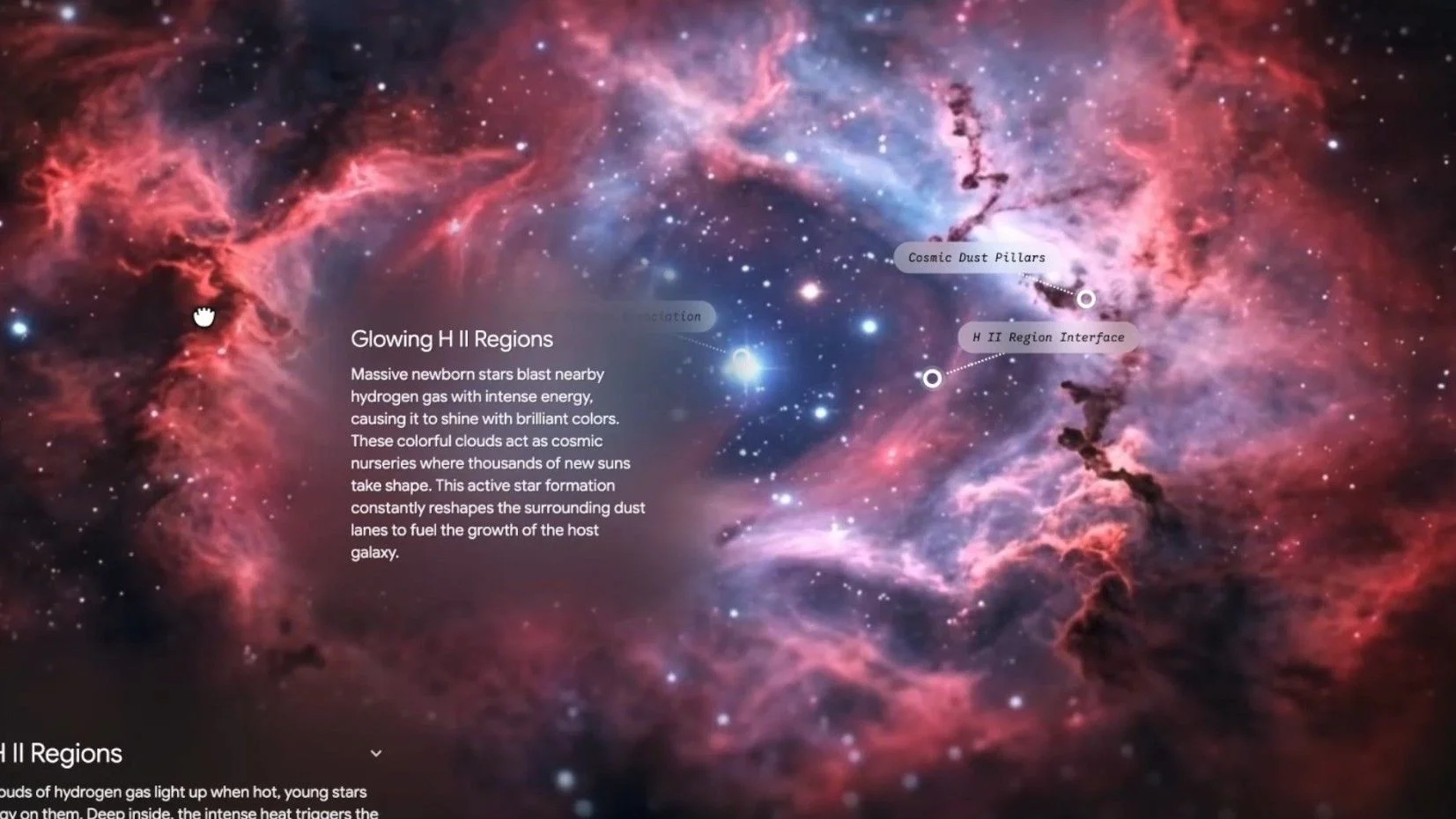
Google is giving students a more visual way to work through complex subjects in Gemini. Its new Immersive Explorations library presents topics as interactive images that students can inspect in layers, adding a navigable format to the company’s expanding set of learning tools. The idea is straightforward: start with a broad view, then follow the details that catch your attention. That can make a dense subject feel more approachable, though the format’s value will depend on how clearly each visual connects its parts to the underlying explanation.
Announced this week, the feature is available in the Gemini student hub and in the Gemini app. Google describes it as a way to explore subjects visually instead of working through long stretches of text. Explanatory paragraphs remain part of each experience, but the main interaction is clicking through visuals to reveal details. That combination matters: an image can orient a student quickly, while text can explain what a feature represents and why it matters. A visual interface on its own, though, doesn't guarantee a better explanation.
From the big picture to specific details
Quasars offer one example of how the format works. Students can begin with a broad view, then select parts of the image to learn about features such as host galaxies and interstellar dust lanes. The sequence lets them move from an overall picture to individual components at their own pace, rather than relying on a fixed order of explanation. For a subject that can feel remote and abstract, that shift in scale may help students connect unfamiliar terms to a visible structure.
There's a practical teaching idea here: let learners choose which detail to inspect, then give them enough context to understand what they're seeing. Similar interactive learning materials often work best when the visual is more than decoration and each click answers a clear question. If you're working through a difficult topic, being able to pause at one component and return to the larger image could make the material easier to follow. The test will be whether the experience gives students a useful mental model, not simply more things to click.
The library also covers dinosaurs, the molecular structure of plants and the physics of lightning, among other subjects. These examples span different kinds of learning: identifying parts of a subject, understanding structures too small to see unaided, and following physical processes. Google's current language support includes English, Indonesian, Hindi, Brazilian Portuguese, French and Simplified Chinese. Students using other languages will see English until additional support becomes available. That limitation may affect how easily students can use the feature, particularly when they need to understand specialized vocabulary in a language they know well.
A wider set of learning tools
Immersive Explorations extends Google's existing work on Gemini for education. When the company brought Gemini to teens using school accounts, it included safeguards and tools for checking AI responses. Students in more than 100 countries also received Coach, a guided feature that uses quizzes and games to help them build subject knowledge. Together, those features show Google adding different ways to study within its Gemini products, from guided practice to visual exploration. The collection is broadening, but that doesn't by itself tell us how well students learn with each tool.
Google has also added Gemini capabilities to Classroom and NotebookLM, now called Gemini Notebook. Teachers can create a subject-specific AI expert to support students who are stuck, then use their teaching materials to produce rubrics and quizzes. These tools place Gemini in several parts of schoolwork: students can seek help, review material and explore a topic, while teachers can prepare learning resources. The common thread is assistance shaped around a subject or lesson. The quality of that assistance still depends on how well the material reflects what students are expected to learn.
And yet, adding AI features to more stages of learning raises a simple question: does each one make the work clearer? A quiz can help a student check recall; a visual exploration may help them see how parts relate. Those are different jobs, and the formats shouldn't be treated as interchangeable. (And this is the part most people overlook.) A student can spend time interacting with a polished experience without necessarily leaving with a stronger grasp of the subject. The explanations, structure and connection to classroom learning will matter as much as the visual presentation.
What the format needs to prove
My read is that the library's value will depend on whether its visual explorations make difficult concepts easier to inspect and remember. Its current range—from distant astronomical structures to plant molecules—gives students a practical way to move through a topic one detail at a time. This is more significant than it looks if the interactions help learners build a coherent picture instead of just revealing isolated facts. The approach has a clear appeal, but the examples alone don't show how much it improves understanding.
For students, the immediate promise is choice: explore a broad view, follow a particular detail, and use the accompanying text when the image needs explanation. For teachers, the question is whether these experiences fit alongside existing lessons and help students discuss concepts more precisely. Google's broader education tools suggest the company wants Gemini to support several parts of that process. What this means for you depends on the subject and the student: some topics benefit from seeing components laid out, while others may still be better served by a careful explanation in words.
Here's the thing: an interactive image is a format, not a teaching result. Students need clear explanations and well-chosen details to make the clicks count. If Immersive Explorations delivers those, it could give learners a useful route into subjects that can be hard to picture. If it doesn't, the novelty may wear off quickly. A promising start, with the evidence still to come.