Honor 700 Teasers Put Heart Rate on the Back of the Phone
The teaser and what it suggests
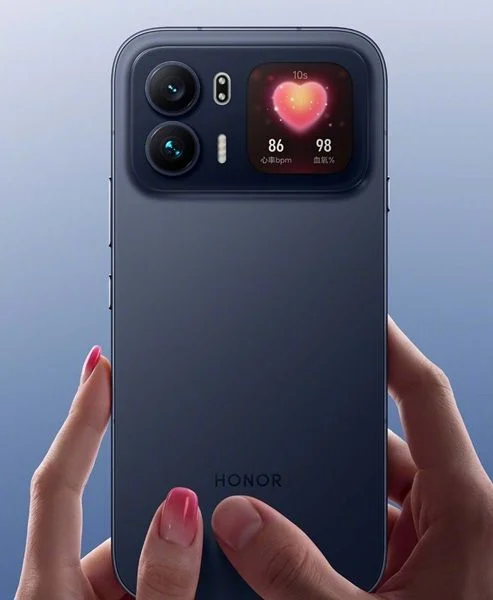
Honor's next phone series will put health tracking on the back of the phone, and that's the part worth paying attention to. The rear display isn't new for this lineup, but the teasers suggest it's doing something more useful than showing notifications. Rear screens have mostly been a novelty, used for selfies, status alerts, and the occasional game. If Honor is pushing them toward vitals, that's a more meaningful shift than another gimmick.
Leaker Digital Chat Station (DCS) posted several alleged details about the Honor 700 series on Weibo, as reported by Huawei Central. According to DCS, the Honor 700 has a 6.5-inch display with very thin bezels and a 200MP camera. The rear screen is the headline feature, though it's smaller than the rear displays Xiaomi uses on its 17 Pro and 18 Pro series. The leaker also mentioned mini-games, "dynamic notifications," and an "industry-exclusive" feature. That last phrase reads like a machine translation, so I wouldn't put much weight on the exact wording. Leaks from this kind of source are often useful for direction and shaky on specifics. Treat everything here as a working hypothesis until Honor says otherwise.
What the rear screen is actually showing
The teaser answers the question about that exclusive feature. It shows the rear screen displaying a user's heart rate (BPM) and blood oxygen level. Honor hasn't explained how it captures those readings. The most likely guess is an in-display sensor doing the job a smartwatch sensor would do, but that's speculation until Honor confirms it. Reading blood oxygen usually depends on specific light wavelengths and a clean optical path, so the sensor hardware matters far more than the screen sitting on top of it.
That matters because a phone that reads vitals from its back is a different proposition from one that just adds a small status screen. If the sensor works reliably, the rear display becomes a glanceable health monitor you don't have to unlock or wake. Here's the thing: optical readings from a phone back depend heavily on how the user holds the device, so accuracy will be the real test. (And this is the part most people overlook) a phone is usually face-down on a desk or sitting in a pocket, which means the sensor's usefulness depends on contact, pressure, and posture as much as on the hardware itself. I'd want to see how the readings hold up during ordinary use, not just in a staged demo.

Honor is moving fast on this lineup
Honor launched the 600 series in April, and the 700 series arrives only months later. That's a short gap between generations, and it tells you Honor is treating its release calendar as a competitive tool. A quick cadence can signal momentum, or it can mean a product line hasn't had long enough to prove itself. The 600 series is a mid-range lineup, and it didn't make much noise.
The base 600 has a 200MP primary camera and a 12MP ultrawide, while the 600 Pro adds a 50MP telephoto lens and a Snapdragon 8 Elite chip. That split is interesting. A flagship-class processor sits in the Pro while the base model runs on a mid-range chip. This is a familiar tiering strategy, and it's the kind of structure that nudges shoppers toward the higher model. The base model runs the mid-range Snapdragon 7 Gen 4.
The 700 series is expected to include three models: the Honor 700, 700 Pro, and 700S. Three tiers is a common lineup structure, and the "S" suffix usually signals a variant with different priorities rather than a straight upgrade. Honor hasn't said what it means here. Beyond the rear screen and the 200MP camera, specs are still unclear. Honor hasn't confirmed them, and the details may differ from model to model, so the safest move is to wait for the November 13 launch in China.
My read on the pricing
I'm a bit surprised Honor is refreshing the line this quickly. The base 600 didn't give anyone much reason to get excited, but the Pro had enough going for it to stand out. Mid-range phones rarely feel exciting, and Honor made the 600 Pro work for at least one buyer. That's a useful signal for the 700 series, because it suggests the company knows where its appeal lies.
The bigger question is price. Memory costs have been climbing, with RAM and storage shortages squeezing phone makers across the market. A rear health display and a 200MP camera are appealing, but if Honor passes those component costs to buyers, the 700 could stop being a mid-range bargain. Phone makers facing higher component costs usually pick from a short list: thinner margins, higher prices, or trimmed specs. If I had to guess where the squeeze lands, it's in the sensor or screen specification rather than the camera. That's the number I'll be watching on November 13.
What this means if you're shopping
If you're weighing an upgrade, the rear screen is the feature to test rather than trust. Check how Honor labels the vitals readings once the phone ships. Wellness estimates and measurements meant for medical decisions are very different things, and marketing copy doesn't always make the distinction clear. Read the fine print before you treat a number on the back of your phone as a health signal.
Health sensing on phones has a mixed record. Consumer devices often present readings with more confidence than they've earned, and optical measurements can shift with movement, pressure, and individual differences. If you're relying on these numbers for anything beyond curiosity, compare them against a dedicated device. What this means for you is simple: the feature is interesting, but it isn't a reason to buy by itself.
And yet, if Honor gets this right, it could push rivals to put sensors somewhere other than the wrist. That's the more interesting outcome, and also the least certain. A phone that reads vitals reliably from its back would change how people think about carrying a health monitor at all. Whether that happens depends on execution the teasers can't show us.
Wait for the reviews. Then decide.